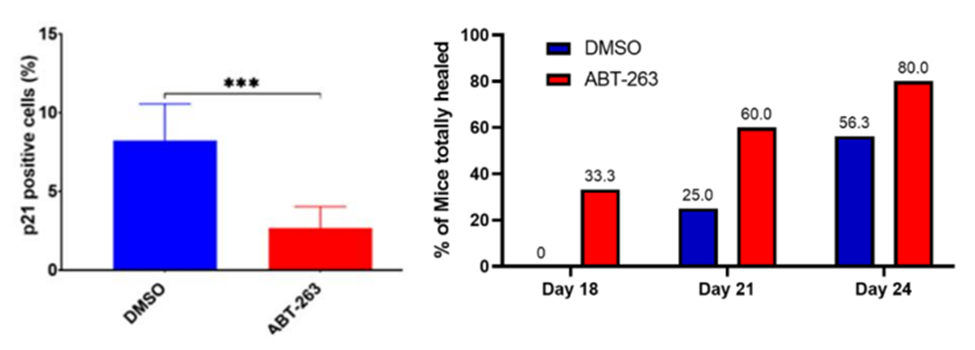
Topical ABT-263, a senolytic drug, cleared aging cells from older mouse skin and raised full wound-closure rates from 56% to 80% by day 24, pointing toward a new preoperative wound-care strategy.
At a Glance: Senolytic Skin Healing vs. Conventional Wound-Care Approaches
Senolytic skin healing is a therapeutic approach in which drugs called senolytics selectively destroy senescent cells — permanently growth-arrested cells that accumulate in aging tissue — to restore the skin's ability to repair itself after injury. A study published in Aging (Albany NY) in December 2024 by researchers at Boston University demonstrated that just five days of topical ABT-263 application raised full wound-closure rates in aged mice from 56% to 80% by day 24, making it one of the first preclinical demonstrations that a senolytic can be delivered directly to skin rather than taken orally.
The findings matter beyond the laboratory bench. Approximately 4 million major surgical procedures are performed on individuals aged 65 and older in the United States each year, and slow wound healing in that population is a leading driver of post-surgical complications, infections, and prolonged hospital stays. A topical preoperative treatment that primes aging skin before a scalpel ever touches it would represent a meaningful clinical advance — if the mouse data translate to humans.
| Feature | Topical ABT-263 (Senolytic) | Standard Moist Wound Dressings | Collagen-Stimulating Topicals (e.g., retinoids) |
|---|---|---|---|
| Primary mechanism | Eliminates senescent cells via Bcl-2/Bcl-xL inhibition | Maintains moisture; passive barrier support | Upregulates collagen gene expression in fibroblasts |
| Target population | Aged tissue with high senescent-cell burden | All wound types and ages | Photoaged or intrinsically aged skin |
| Application timing | Pre-injury / preoperative (5-day course) | Applied after wound occurs | Ongoing maintenance use |
| Wound-closure improvement (aged mice, day 24) | 80% full closure vs. 56% control (+24 pp) | Variable; no comparative senolytic data | No direct wound-closure RCT data in aged skin |
| Selectivity for aged tissue | Yes — no effect observed in young mice | Not age-selective | Partial; works in younger skin too |
| Route of delivery | Topical (skin surface) | Topical (wound surface) | Topical |
| Human evidence | Preclinical only (as of 2026) | Extensive clinical evidence | Extensive clinical evidence |
| Key risk / limitation | Systemic senolytic side effects if absorbed; needs human trials | Does not address cellular senescence | Irritation; does not clear senescent cells |
The table highlights the conceptual gap ABT-263 fills: it acts upstream of the wound event, clearing the cellular debris that would otherwise blunt the repair response, rather than managing the wound after the fact.
What Exactly Are Senescent Cells, and Why Do They Accumulate in Aging Skin?
Cellular senescence is a state of permanent cell cycle arrest that occurs when a cell encounters stress — DNA damage, oxidative injury, telomere shortening — and stops dividing without dying. The cell remains metabolically active and begins secreting a cocktail of inflammatory cytokines, proteases, and growth factors collectively called the senescence-associated secretory phenotype, or SASP. The SASP can trigger inflammation, promote degradation of the extracellular matrix, and disrupt the structural integrity and regenerative capacity of the skin, leading to wrinkles, loss of elasticity, and impaired wound healing.
In young skin, senescent cells are cleared efficiently by the immune system. With age, that clearance slows, and senescent fibroblasts, keratinocytes, and melanocytes accumulate. Skin cell types including fibroblasts, keratinocytes, and melanocytes can all acquire the phenotype of cellular senescence, and their chronic presence — as opposed to the transient presence seen in normal wound healing — is what tips the balance from beneficial to harmful.
There is a paradox worth understanding here: a brief, controlled burst of senescence is actually part of normal wound repair. Transiently senescent cells at a wound edge secrete SASP factors that recruit immune cells and signal neighboring cells to proliferate. The problem in aged skin is that this transient signal never resolves. The senescent cells stay, the SASP smolders chronically, and the repair machinery stays stuck in a low-grade inflammatory state that never fully transitions to the proliferative and remodeling phases of healing.
What Is ABT-263 and How Does It Work as a Senolytic?
ABT-263, also known by its pharmaceutical name navitoclax, is a small-molecule inhibitor that targets the anti-apoptotic proteins Bcl-2 and Bcl-xL. Senescent cells depend heavily on these proteins to survive — they are, in a sense, cells that have been "told" to die but have found a way to resist. By disrupting these survival pathways, ABT-263 triggers apoptosis specifically in senescent cells, thereby reducing their presence in tissues and restoring regenerative potential.
This selectivity is the defining feature of senolytics as a drug class. Unlike broad anti-inflammatory agents that suppress the entire immune response, senolytics aim to remove the source of chronic inflammation rather than mute its downstream effects. In the Boston University study, the selectivity was confirmed experimentally: ABT-263 reduced senescent cells in aged mice without producing the same effect in young mice, consistent with the idea that the drug has more target cells to work on in older tissue.
ABT-263 has been studied in oncology as a potential cancer treatment — Bcl-2 and Bcl-xL are also overexpressed in some tumor cells — but its use as a senolytic represents a distinct application. In the wound-healing study, it was not given orally (the route used in cancer trials, which carries risks including thrombocytopenia due to Bcl-xL inhibition in platelets) but applied directly to the skin surface, which the researchers hypothesized could limit systemic exposure and reduce off-target effects.
What Did the Boston University Study Actually Find?
The study, titled "Topical ABT-263 treatment reduces aged skin senescence and improves subsequent wound healing" and published in Aging on December 3, 2024, was led by Maria Shvedova and Daniel S. Roh from Boston University's Division of Plastic and Reconstructive Surgery. The full paper is available via PubMed (PMID 39630941) and PubMed Central (PMC11810067).
The experimental design was straightforward. Researchers applied ABT-263 topically to the dorsal skin of 24-month-old mice — roughly equivalent to elderly humans — for five consecutive days, then created standardized excisional wounds and tracked closure over the following weeks.
Key findings:
- Treated aged skin showed significantly decreased gene expression of senescence markers p16 and p21, along with reductions in senescence-associated beta-galactosidase (SA-β-gal) and p21-positive cells compared to DMSO-treated controls.
- By day 18 post-injury, nearly 33% of treated mice had achieved complete wound closure, compared to none in the untreated group.
- By day 24, 80% of the ABT-263 group had fully healed, a 24-percentage-point improvement over untreated mice.
- Bulk RNA sequencing of treated skin revealed upregulation of genes associated with hemostasis, inflammation, cell proliferation, angiogenesis, collagen synthesis, and extracellular matrix organization — essentially the full wound-healing cascade.
- ABT-263 triggered a temporary inflammatory response and macrophage infiltration in treated skin, which paradoxically appeared to prime the repair machinery rather than impair it.
The RNA sequencing data are particularly significant because they show that ABT-263 did not simply remove damaged cells and leave a void. It actively shifted the transcriptional landscape of aged skin toward a state resembling the early phases of wound repair — before any wound had been made.
Why Did Inflammation Go Up After a Drug Meant to Reduce Damage?
This is one of the more counterintuitive findings in the study, and it deserves careful interpretation.
When ABT-263 kills senescent cells, those cells release their contents — including SASP factors — in a final burst as they undergo apoptosis. This triggers a transient inflammatory response and macrophage recruitment. In the context of chronic low-grade inflammation driven by persistent senescent cells, this might seem like a step backward. The researchers interpret it differently, however.
The brief increase appeared to help activate the skin's repair machinery, allowing it to respond more rapidly once a wound occurred. The distinction is between chronic, unresolved inflammation — which impairs healing — and acute, time-limited inflammation, which is a necessary first phase of wound repair. By clearing senescent cells and triggering a clean, acute inflammatory signal, ABT-263 may essentially be resetting the skin's inflammatory clock, allowing it to run through the normal repair sequence properly when a wound is subsequently made.
This interpretation is consistent with broader research on senescence in wound healing. Cellular senescence has been found to both promote and inhibit cutaneous wound healing processes, and the key variable appears to be duration: transient senescence helps, chronic senescence hurts. ABT-263 appears to convert the chronic state into something closer to a transient one.
How Does This Compare to What We Already Know About Senolytics in Skin?
The broader literature on senolytics in skin has been building for several years. A 2021 review in Mechanisms of Ageing and Development noted that senolytics eliminate senescent skin cells with cell type specificity, but should be used with caution in clinical settings, citing the complexity of skin senescence across fibroblasts, keratinocytes, and melanocytes.
That review also drew attention to the paradox that the transient presence of senescent cells is believed to be beneficial in the context of development and wound healing, while the chronic presence of senescent cells is detrimental in the context of aging, diseases, and chronic wounds. The Boston University study navigates this paradox by timing the senolytic treatment as a preconditioning step — clearing the chronic burden before a wound is created, rather than applying it to an active wound where transiently senescent cells might be playing a useful role.
Earlier senolytic research in other tissues (fat, muscle, lung) had shown that systemic clearance of senescent cells could improve regeneration, but the skin-specific, topical approach is relatively novel. The topical delivery route addresses one of the main safety concerns with ABT-263: when taken orally, it inhibits Bcl-xL in platelets, which can cause dangerous drops in platelet counts. Applying it to the skin surface, the researchers reasoned, could achieve local senolysis with lower systemic exposure — though this hypothesis still needs to be tested rigorously in humans.
What Are the Implications for Surgical Recovery and Chronic Wound Care?
The researchers explicitly frame their findings in the context of preoperative care. From the study: "Our study show the potential of topical senolytic treatments to enhance wound healing in aging skin, presenting a promising strategy for preoperative care."
The clinical logic is appealing. Before a planned surgical procedure — a hip replacement, a skin graft, a tumor excision — a patient could apply a topical senolytic to the operative site for several days. If the human data mirror the mouse data, the skin would enter surgery with a lower senescent-cell burden, a primed transcriptional response, and a greater capacity to close the wound quickly. For older patients, who already face elevated risks of surgical site infections and delayed healing, even a modest improvement in closure rates could translate to meaningful reductions in complications.
Chronic wounds — diabetic foot ulcers, venous leg ulcers, pressure injuries — represent an even larger unmet need. These wounds are characterized by exactly the kind of chronic, unresolved inflammation and impaired tissue remodeling that senescent cells drive. Whether a topical senolytic could help break the cycle in established chronic wounds (as opposed to preventing impaired healing before it starts) is an open question the current study does not answer, but it is a logical next step for the research program.
For readers interested in how collagen production fits into broader skin aging and repair, our guide to best plumping and collagen-boosting serums explains the structural role collagen plays in skin integrity — context that helps clarify why ABT-263's upregulation of collagen synthesis genes is mechanistically significant.
What Are the Limitations and What Needs to Happen Before This Reaches Patients?
The study is preclinical. Every result described above comes from mice, and mouse skin differs from human skin in meaningful ways — it is thinner, heals partly by contraction rather than re-epithelialization, and has a different immune cell composition. The researchers are explicit that additional research will be needed before its safety or effectiveness in people is known.
Several specific gaps need to be addressed before clinical translation:
Pharmacokinetics of topical delivery. How much ABT-263 penetrates the skin barrier and reaches systemic circulation? What is the local tissue concentration? These questions determine both efficacy and safety in humans.
Platelet safety. Oral ABT-263 causes thrombocytopenia by inhibiting Bcl-xL in platelets. Even topical delivery could carry this risk if absorption is significant, and any human trial will need careful platelet monitoring.
Optimal dosing and timing. The mouse study used a five-day pretreatment protocol. Whether a shorter or longer course, or a different timing relative to surgery, would be more effective or safer in humans is unknown.
Efficacy in human aged skin. Human skin accumulates senescent cells differently than mouse skin, and the specific cell types and SASP profiles may differ. The transcriptional response seen in mice may not replicate exactly.
Long-term effects. Senescent cells are not purely harmful — they play roles in tumor suppression and embryonic development. Chronic or repeated senolytic treatment could theoretically have unintended consequences, though a short preoperative course seems lower risk than ongoing systemic use.
Despite these caveats, the study adds meaningful data to a growing body of evidence that targeting cellular senescence is a viable strategy for improving skin health in older adults. The field of senolytics has been advancing rapidly, with multiple compounds now in early-phase human trials for age-related conditions. Skin wound healing, with its clear clinical endpoints and accessible treatment site, may prove to be one of the faster paths to a clinical application.
What Does This Mean for the Future of Anti-Aging Skin Science?
The broader significance of this research extends beyond wound care. If senescent cells are a root cause of impaired skin function in aging — not just slow healing, but also reduced elasticity, thinning, and impaired barrier function — then senolytics could eventually become a foundational tool in dermatology and aesthetic medicine, not just surgery.
Current anti-aging topicals work largely by stimulating collagen production, blocking UV damage, or providing antioxidant support. They address the downstream consequences of skin aging without touching the upstream driver: the accumulation of dysfunctional cells that actively degrade the tissue environment. A senolytic approach would work at a different level, removing the cells that are poisoning the tissue rather than trying to compensate for the damage they cause.
The field still needs to grapple with the selectivity challenge. Cellular senescence of skin cells can be studied and measured, but identifying a sole specific biomarker for defining this state remains difficult. Without a reliable way to confirm that a treatment is hitting senescent cells and not healthy ones, clinical use carries real uncertainty. The fact that ABT-263 showed no effect in young mice — where senescent cells are sparse — is encouraging, but human skin is more heterogeneous than mouse skin, and the margin of selectivity in a clinical setting remains to be established.
The Boston University study represents a well-designed, peer-reviewed proof of concept. It establishes that topical senolytic delivery is feasible, that it can measurably reduce senescence markers in aged skin, and that the downstream effect on wound healing is substantial enough to be statistically significant. The path from these results to a product a surgeon could apply before an incision is long, but the direction is clear.
Sources
- Breakthrough drug reverses skin aging and dramatically speeds healing | ScienceDaily
- Topical ABT-263 treatment reduces aged skin senescence and improves subsequent wound healing - PubMed
- Topical ABT-263 treatment reduces aged skin senescence and improves subsequent wound healing - PMC
- Senolytic Treatment Rejuvenates Aging Skin and Enhances Wound Healing | NMN.com
- ABT-263 treatment rejuvenates aged skin and enhances wound healing | EurekAlert!
- Role of Senescent Cells in Cutaneous Wound Healing - PMC
- Promises and challenges of senolytics in skin regeneration, pathology and ageing | Mechanisms of Ageing and Development
- Aging (Aging-US) — Impact Journals