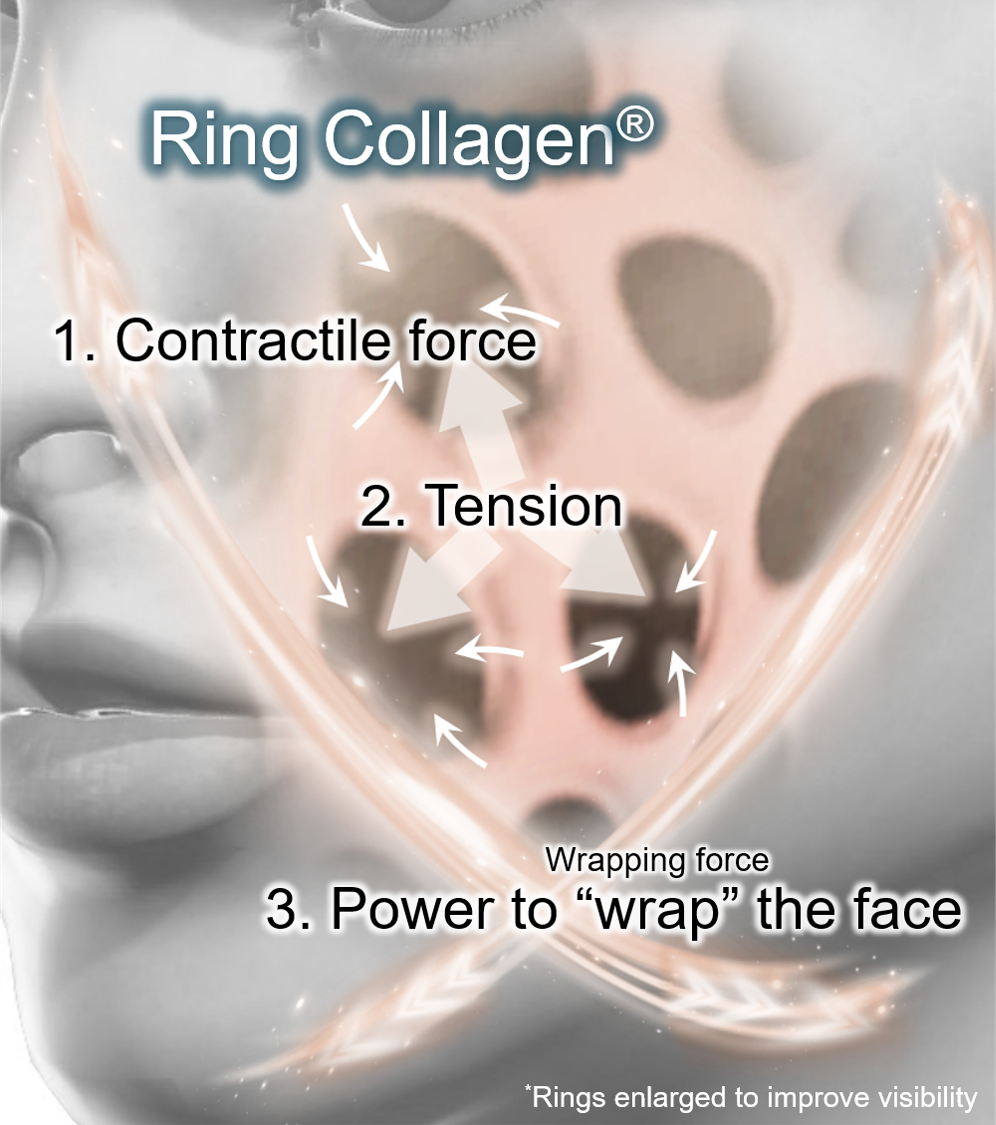
Ring Collagen® is a newly discovered ring-shaped collagen structure in facial skin that generates tension to prevent sagging, identified by Shiseido in 2026 using AI-powered 3D imaging.
What Is Ring Collagen® and How Does It Maintain Facial Firmness? Shiseido's 2026 Discovery
Ring Collagen® is a ring-shaped collagen structure found in human facial skin, officially named and trademarked by Shiseido following its discovery and announcement in July 2026. Located around vellus hairs and sebaceous glands, these microscopic collagen rings generate internal skin tension that helps maintain a firm, youthful facial contour — and their deterioration with age is now understood to be a direct contributor to sagging.
This discovery represents one of the most structurally specific findings in skin biology in recent years. Rather than simply confirming that collagen declines with age, Shiseido's research team identified a precise architectural mechanism: individual rings of collagen contract and pull against each other, producing measurable tensile forces within the dermis. When that ring architecture breaks down, so does the skin's ability to hold its shape.
The research was conducted in collaboration with Dr. Kyoichi Matsuzaki, chief of external plastic surgery at the International University of Health and Welfare, alongside researchers from Jichi Medical University and the National Institute for Physiological Sciences. It was presented at the International Federation of Societies of Cosmetic Chemists (IFSCC) Congress, where it was selected as a top 10 finalist.
Here is a snapshot of how Ring Collagen® compares to other key structural components and concepts in skin aging science:
| Feature | Ring Collagen® | Conventional Collagen Fibers | Proteoglycans |
|---|---|---|---|
| Structure | Ring-shaped, encircles hair follicles and sebaceous glands | Linear fibrous bundles in the dermis | Gel-like macromolecules filling extracellular matrix |
| Primary function | Generates internal skin tension to maintain facial firmness | Provides tensile strength and structural scaffolding | Hydrates tissue, supports collagen fiber organization |
| Location in skin | Around vellus hairs and sebaceous glands | Throughout the dermis | Distributed across dermis and epidermis |
| Age-related change | Deteriorates as proteoglycan levels decline | Quantity and quality decrease; cross-linking increases | Levels decline, reducing hydration and structural support |
| Discovery status | Newly identified in 2026 by Shiseido | Well-established for decades | Well-established for decades |
| Restoration potential | Rosehip extract, safflower extract, moderate physical stimulation | Stimulated by retinoids, peptides, vitamin C | Stimulated by hyaluronic acid precursors, growth factors |
| Visualization tool | Digital-Skin Reality® (AI-powered 3D force mapping) | Standard histology, electron microscopy | Immunohistochemistry, biochemical assays |
What exactly is Ring Collagen® and where is it found in the skin?
Ring Collagen® is a ring-shaped collagen architecture that forms concentrically around vellus hairs — the fine, short hairs that cover most of the face — and around sebaceous glands, the oil-producing structures attached to those follicles. Unlike the more familiar linear collagen fibers that run in bundles through the dermis providing general tensile strength, Ring Collagen® forms closed loops that function more like tension springs.
Shiseido's official announcement describes how individual rings of collagen contract and pull against each other, generating tension distributed across the skin. Think of it as a network of interlocked rubber bands: each ring pulls on its neighbors, and the cumulative effect is a surface that resists deformation and holds its shape.
The location of Ring Collagen® around vellus hairs and sebaceous glands carries real significance. These structures are densely distributed across the face — far more so than on other areas of the body — which may help explain why facial skin has distinct firmness characteristics compared to, say, skin on the forearm. The ring architecture essentially uses the follicular and glandular structures as anchor points, turning them into nodes in a tension-generating network.
This departs meaningfully from how the field has historically thought about skin firmness. Most anti-aging research has focused on the total quantity of collagen in the dermis, the degree of cross-linking between fibers, or the hydration state of the extracellular matrix. Ring Collagen® introduces a new variable: the geometric organization of collagen around specific micro-anatomical features, and the mechanical forces that organization produces.
How did Shiseido discover Ring Collagen®, and what is Digital-Skin Reality®?
The discovery of Ring Collagen® was enabled in large part by a new imaging technology Shiseido developed alongside the research: Digital-Skin Reality®, an AI-powered 3D visualization platform designed to map the physical forces generated within skin tissue rather than simply imaging its structure.
Most conventional skin imaging tools — including standard histology, confocal microscopy, and electron microscopy — show what skin looks like at a microscopic level. They reveal structure, texture, and composition. What they cannot do is show the mechanical forces operating within that structure: where tension is being generated, how it is distributed, and what happens to force patterns when the tissue ages or is treated with an ingredient.
Digital-Skin Reality® moves visualization from the tangible world — seeing structure and movement — to the intangible world of physical forces generated within the skin. The platform also moves visualization out of a flat monitor screen and into three-dimensional real space, allowing researchers to interact with force maps in a more intuitive way.
Through this technology, the tension-generating mechanism of Ring Collagen® was confirmed. Researchers could observe not just that the ring-shaped collagen structures existed, but that they were actively producing measurable tensile forces — and that those forces diminished when the ring architecture was disrupted. This distinction between observing structure and observing function is what makes Digital-Skin Reality® a genuinely novel tool in dermatological research.
The collaboration with academic and medical institutions — the International University of Health and Welfare, Jichi Medical University, and the National Institute for Physiological Sciences — lent the research multi-disciplinary rigor that supports its credibility. The IFSCC Congress top-10 finalist recognition further signals that the broader cosmetic science community regards the findings as substantive.
How does Ring Collagen® deteriorate with age, and why does that cause sagging?
Ring Collagen® deteriorates through a process driven primarily by the age-related decline in proteoglycans — a class of large, complex molecules that fill the extracellular matrix of the dermis and matter for organizing and supporting collagen fiber architecture.
Proteoglycans bind water, cushion the tissue, and help maintain the spatial organization of collagen fibers. As the body ages, proteoglycan synthesis slows and existing proteoglycans are degraded more rapidly than they are replaced. The result is a dermis that becomes progressively less organized, less hydrated, and less mechanically resilient.
What Shiseido's research adds to this established picture is specificity: the decline in proteoglycans does not just reduce general collagen support — it specifically disrupts the ring-shaped architecture of Ring Collagen®. Global Cosmetics News reports that Ring Collagen® structure deteriorates as proteoglycan levels decline with age, and this deterioration contributes directly to the loss of skin tension that manifests as sagging.
The mechanical logic is straightforward. If Ring Collagen® is a network of tension-generating loops anchored around follicles and glands, then disrupting the integrity of those loops reduces the tension they produce. Less tension means the skin has less internal resistance to the downward pull of gravity and the repeated mechanical stresses of facial expression. Over years and decades, that reduced resistance allows the skin to gradually descend — the anatomical process we recognize as sagging of the cheeks, jowls, and jawline.
This framing recontextualizes sagging not merely as a loss of volume or a reduction in collagen quantity, but as a failure of a specific tension-generating architecture. That distinction has real implications for how future anti-aging treatments might be designed.
What ingredients and interventions can restore Ring Collagen® structure?
Shiseido's research identified three interventions that improve Ring Collagen® structure by increasing proteoglycan-related activity: rosehip extract, safflower (benibana) extract, and moderate physical stimulation. Each works through a somewhat different pathway, and the combination suggests that restoring Ring Collagen® may require a multi-modal approach.
Rosehip extract has a well-established reputation in skincare for its high concentration of essential fatty acids — particularly linoleic acid and alpha-linolenic acid — as well as vitamin C and trans-retinoic acid, a natural form of retinoid. These components have been shown in prior research to support collagen synthesis and extracellular matrix organization. Within the context of Ring Collagen®, rosehip extract appears to support the proteoglycan activity that maintains the ring architecture, though the precise molecular mechanism has not yet been detailed in publicly available materials.
Safflower extract, derived from the benibana flower (Carthamus tinctorius), is rich in linoleic acid and flavonoids. It has been used in traditional Japanese medicine for centuries and has more recently attracted attention in cosmetic science for its potential to support skin barrier function and reduce inflammation. Its role in Ring Collagen® restoration appears to relate to its ability to modulate proteoglycan-related activity in the dermis.
Moderate physical stimulation may be the most intriguing of the three findings, because it points toward a category of intervention that goes beyond topical skincare. The research suggests that mechanical input to the skin — the kind that might be delivered by facial massage, microcurrent devices, or other physical modalities — can positively influence Ring Collagen® structure. This aligns with a broader trend in beauty technology toward skin tension skincare, which shifts focus from ingredient absorption to preserving the skin's natural structural mechanics.
The combination of a botanical topical approach with a physical stimulation approach is significant from a product development standpoint. It suggests that future skincare systems targeting Ring Collagen® may need to pair a serum or cream containing rosehip and safflower extracts with a device component — whether a facial roller, a microcurrent tool, or a purpose-built device — to achieve meaningful results.
The data on these interventions is currently limited to what Shiseido has disclosed in its press materials and conference presentation. Independent replication and peer-reviewed publication of the full methodology and results would strengthen the evidence base considerably. The field should treat these findings as a compelling and well-resourced starting point rather than a fully settled conclusion.
What does this mean for the future of anti-aging skincare?
The discovery of Ring Collagen® represents a conceptual shift in how the skincare industry might approach facial aging — and that shift has implications across formulation science, device technology, and consumer communication.
For formulators, the finding introduces a new target: not just collagen quantity, but the preservation and restoration of a specific collagen geometry. Ingredients that support proteoglycan synthesis or activity become newly relevant as Ring Collagen® modulators, not just general matrix support agents. This could drive renewed interest in proteoglycan-boosting actives such as certain growth factors, plant-derived polysaccharides, and specialized peptides, now evaluated through the lens of their effect on ring architecture specifically.
For the beauty technology sector, the research validates the growing category of mechanical skincare — devices and treatments that deliver physical stimulation to the skin. If moderate mechanical input can restore Ring Collagen® structure, then facial devices gain a new, biologically grounded rationale that goes beyond the anecdotal. Trend Hunter notes this opens new opportunities for hybrid skincare systems that combine topical formulas with device-based mechanical benefits, particularly in the premium market where consumers are willing to invest in science-backed solutions.
For consumer communication, Ring Collagen® offers a concrete, visualizable story about why skin sags — one that is more mechanistically specific than the familiar "collagen declines with age" narrative. Explaining that the skin contains a network of tension-generating collagen rings, and that preserving those rings is what keeps the face looking firm, gives consumers a more tangible mental model for what anti-aging products are actually trying to do.
Digital-Skin Reality® also has long-term implications beyond this single discovery. If AI-powered 3D force mapping can be applied to skin tissue reliably, it becomes a platform for identifying other previously invisible structural mechanisms in skin aging. The technology essentially creates a new category of biological question that can be asked: not just "what does this structure look like?" but "what forces is it generating, and how do those forces change with age or treatment?" That is a more powerful research tool.
How does Ring Collagen® fit into the broader space of skin biology?
To appreciate the significance of Ring Collagen®, it helps to understand where it sits within the established architecture of skin. Human skin is organized into three primary layers: the epidermis (the outer barrier layer), the dermis (the structural middle layer where collagen and elastin live), and the hypodermis (the deeper fat and connective tissue layer). Ring Collagen® resides in the dermis, specifically in the zones immediately surrounding the pilosebaceous units — the combined structures of the hair follicle and its associated sebaceous gland.
The dermis is already known to contain multiple types of collagen. Type I collagen is the most abundant, forming the thick fiber bundles that give skin its tensile strength. Type III collagen is thinner and more elastic, associated with younger, more resilient skin. Type IV collagen forms the basement membrane that separates the dermis from the epidermis. Ring Collagen® appears to represent a distinct organizational pattern — a geometric arrangement of collagen fibers rather than a new collagen type per se — though Shiseido has not yet publicly specified which collagen type or types form the ring structures.
The relationship between Ring Collagen® and elastin is also not yet fully characterized in available public materials. Elastin fibers work alongside collagen to give skin its rebound quality — the ability to spring back after being stretched or compressed. It is plausible that elastin plays a role in the tension dynamics of Ring Collagen® rings, but this remains to be established in future research.
What is clear is that Ring Collagen® adds a new layer of complexity to the dermis that was not previously mapped. The skin is not simply a matrix of collagen and elastin fibers embedded in a proteoglycan gel — it also contains geometrically organized tension structures anchored to specific micro-anatomical features. That level of architectural specificity is genuinely new information, and it suggests that the dermis is a more mechanically sophisticated tissue than the field has previously recognized.
Who conducted the research and how credible is it?
The Ring Collagen® research was conducted by Shiseido in collaboration with three external academic and medical institutions: the International University of Health and Welfare (where lead collaborator Dr. Kyoichi Matsuzaki is chief of external plastic surgery), Jichi Medical University, and the National Institute for Physiological Sciences. This multi-institutional structure reduces the risk of single-lab bias and brings diverse expertise to the project.
The research was presented at the IFSCC Congress — the International Federation of Societies of Cosmetic Chemists — one of the most prestigious scientific forums in the global cosmetics and personal care industry. Being selected as a top 10 finalist at the IFSCC Congress represents meaningful peer recognition, as submissions are evaluated by an international panel of cosmetic scientists.
Shiseido has a long track record of publishing substantive skin biology research. The company's research division has previously contributed to understanding of melanocyte biology, UV damage mechanisms, and skin barrier function, and its findings have appeared in peer-reviewed journals. That institutional context supports taking the Ring Collagen® discovery seriously as a scientific claim, even while acknowledging that full peer-reviewed publication of the Ring Collagen® data has not yet been confirmed in publicly available sources as of July 2026.
Cosmetics & Toiletries covered the discovery, further indicating that the scientific community regards the findings as credible and newsworthy.
What should consumers and skincare professionals take away from this discovery?
For consumers, the most practical near-term takeaway is that ingredients already present in many skincare products — rosehip oil and safflower oil — have now been linked to a specific biological mechanism in facial skin: the preservation of Ring Collagen® through proteoglycan-related activity. This does not mean every product containing these ingredients will deliver meaningful Ring Collagen® benefits, since concentration, formulation, and delivery system all matter. But it does provide a new rationale for seeking out products that feature these botanicals in meaningful concentrations, particularly in the context of anti-aging and firming claims.
The finding about moderate physical stimulation is also practically relevant. Facial massage, gua sha, and microcurrent devices have been popular in the beauty space for years, often with limited mechanistic justification. The Ring Collagen® research offers a plausible biological explanation for why consistent, moderate mechanical stimulation of facial skin might support firmness over time — not just by improving circulation or lymphatic drainage, but by directly influencing the structural integrity of the collagen network.
For skincare professionals — estheticians, dermatologists, and cosmetic chemists — the discovery opens a new framework for evaluating anti-aging protocols. Treatments that combine topical actives with physical modalities (such as a rosehip-containing serum applied before a microcurrent or radiofrequency treatment) may now have a more specific mechanistic rationale. The Digital-Skin Reality® platform also suggests that future clinical assessment tools may be able to visualize Ring Collagen® integrity directly, enabling more personalized treatment recommendations.
The broader lesson from Ring Collagen® is that skin biology still holds significant undiscovered territory. A structure as fundamental as a tension-generating collagen ring around every vellus hair follicle on the face was not identified until 2026, despite decades of intensive dermatological research. That should inspire both humility about what we think we know and genuine excitement about what remains to be found — particularly as AI-powered imaging tools like Digital-Skin Reality® make previously invisible biological phenomena accessible to scientific inquiry.
If you're interested in other science-backed approaches to scalp and skin health, our coverage of best Japanese hair growth serums for thinning hair explores how Japanese cosmetic science is advancing hair follicle biology alongside skin research.
Sources
- Shiseido identifies Ring Collagen® structure linked to facial firmness - Global Cosmetics News
- Shiseido Official Press Release: Ring Collagen® Discovery
- Shiseido Discovers Ring Collagen Structure to Create Tension, Maintain Face Shape - Cosmetics & Toiletries
- Skin Tension Skincare: Shiseido Maps Ring Collagen to Support Firmer-Looking Skin - Trend Hunter