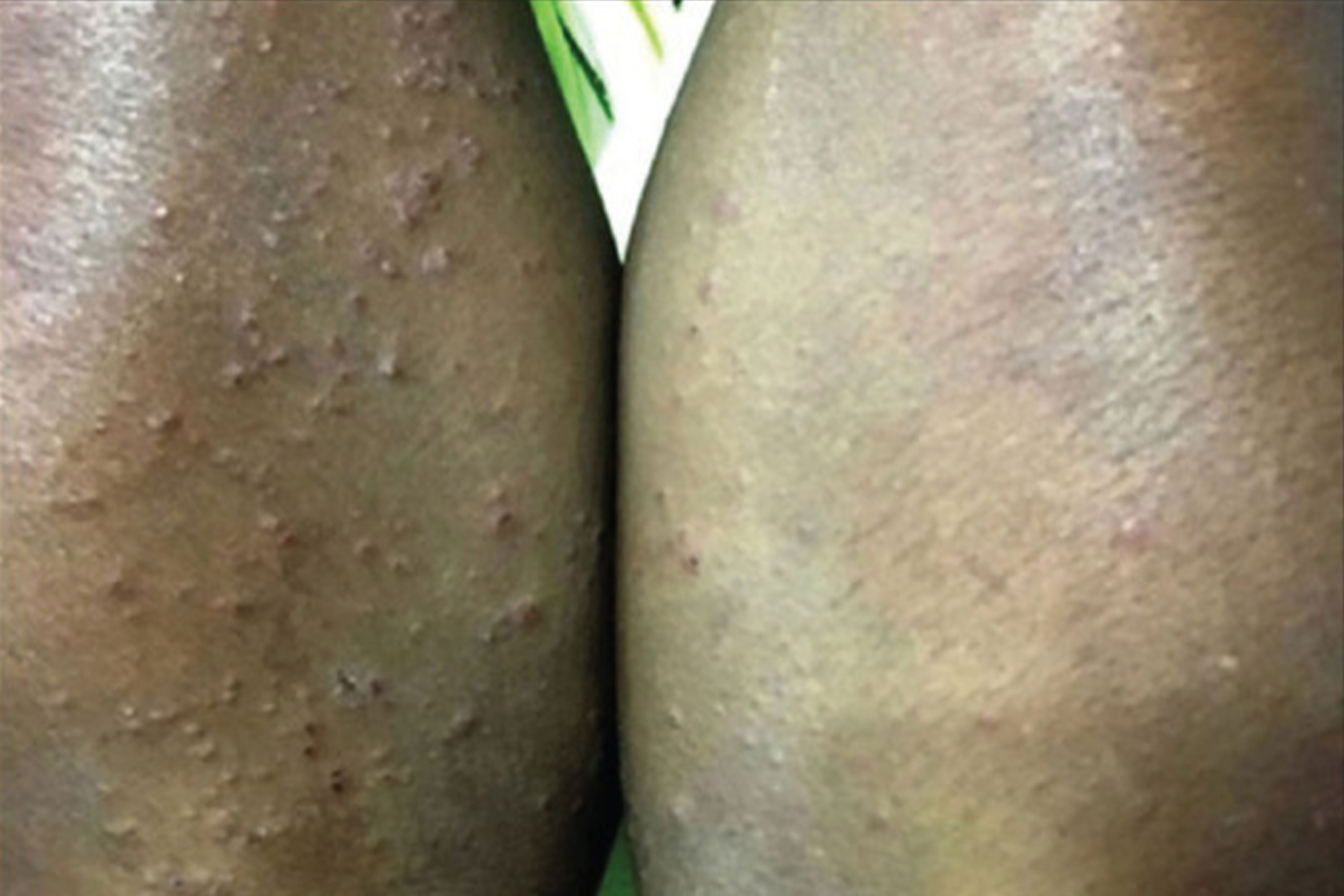
Follicular eczema is a hair-follicle-centered subtype of atopic dermatitis that is more common in darker skin tones, presenting as dark or ashy bumps rather than red patches, and is treatable once correctly diagnosed.
What Is Follicular Eczema? How It Presents on Black and Brown Skin and What Actually Treats It
Follicular eczema is a subtype of atopic dermatitis in which inflammation clusters specifically around hair follicles, producing small, rough, raised bumps (follicular papules) rather than the flat, scaly plaques most people associate with eczema. It occurs more frequently in people with darker skin tones and is one of the most commonly misidentified skin conditions in Black and Brown patients — often dismissed as goosebumps, keratosis pilaris, or simply dry skin.
"Follicular eczema is one of the most common ways eczema presents in skin of color, and yet most patients have never heard the term before they come to see me," says Dr. Neha Chandan, a double board-certified dermatologist and Mohs surgeon based in St. Petersburg, Florida.
Understanding what this condition actually looks like — and how it differs from look-alike conditions — is the first step toward getting the right diagnosis and the right treatment.
At a Glance: Follicular Eczema vs. Keratosis Pilaris vs. Papular Eczema
Before diving deeper, here is a quick comparison of the three conditions most commonly confused with one another:
| Feature | Follicular Eczema | Keratosis Pilaris (KP) | Papular Eczema |
|---|---|---|---|
| Primary lesion | Follicular papules (inflamed bumps around follicles) | Rough, plugged follicles from keratin buildup | Small raised bumps on torso, arms, legs |
| Typical location | Chest, back, arms, scalp — large body areas | Backs of arms, outer thighs, cheeks | Torso, arms, legs |
| Cause | Immune-mediated inflammation (atopic dermatitis) | Keratin protein buildup in follicle | Immune-mediated inflammation (atopic dermatitis) |
| Itch level | Moderate to severe | Usually mild or absent | Moderate to severe |
| Appearance on dark skin | Dark brown, purple, or ashy bumps | Skin-colored or slightly red bumps | Dark brown, purple, or ashy bumps |
| Appearance on light skin | Reddish bumps | Reddish or skin-colored bumps | Reddish bumps |
| Post-flare pigment change | Hypo- or hyperpigmentation common | Rare | Hypo- or hyperpigmentation common |
| Responds to moisturizer alone | Yes (mild cases) | Partially | Yes (mild cases) |
| May need prescription treatment | Yes (moderate–severe) | Rarely | Yes (moderate–severe) |
Sources: Allure / Dr. Kazlouskaya; Indiana University DermaTrials; Healthline
What exactly is follicular eczema, and why does it happen?
Follicular eczema is a form of atopic dermatitis in which the inflammatory response concentrates at the hair follicle opening rather than spreading across the broader skin surface. The result is a field of tiny, firm bumps that can cover large areas of the body — chest, back, arms, legs, and scalp — and that itch intensely.
The exact cause remains unknown, but research points to three overlapping factors:
Genetics. Some people inherit mutations that weaken the structural proteins of the skin barrier, making the skin more permeable to allergens and irritants.
Immune dysregulation. The immune system overreacts to environmental triggers — dust mites, certain foods, harsh detergents, humidity — producing the inflammation that drives follicular papules.
A compromised skin barrier. People with atopic dermatitis typically have a deficiency in ceramides, the lipid molecules that hold the skin barrier together and keep moisture in. Studies comparing skin-barrier properties across ethnic groups have found that Black skin tends to have lower ceramide levels compared to Caucasian or Asian skin, leaving it more reactive and more prone to barrier breakdown.
The National Eczema Association notes that people with a personal or family history of asthma, hay fever, or eczema are at elevated risk — and that people with skin of color face additional systemic barriers, including fewer providers trained to recognize eczema on darker skin, providers who may underestimate disease severity, and limited access to advanced medical therapies.
Why does follicular eczema look so different on Black and Brown skin?
This is one of the most clinically important questions for patients who have spent years being told their bumps are "just dry skin."
On lighter skin tones, eczema — including the follicular subtype — typically appears as a red rash. Redness is the classic teaching-hospital image. On darker skin tones, though, the inflammatory signal that produces redness is masked by higher concentrations of melanin. Instead, follicular eczema on Black and Brown skin presents as:
- Dark brown, purple, or ashy-gray bumps clustered around follicles
- Thickened or hardened patches (lichenification) from repeated scratching
- Extensive skin dryness, sometimes with dark circles around the eyes
- Post-inflammatory hyperpigmentation or hypopigmentation after flares resolve
Dr. Viktoryia Kazlouskaya, a double board-certified cosmetic and medical dermatologist in New York City, explains that the distribution of bumps is one key diagnostic tell: keratosis pilaris favors the backs of the arms, outer thighs, and cheeks, while follicular eczema tends to involve much larger areas of the body, including the chest, back, and scalp.
The pigmentary aftermath is also significant. As documented in educational resources for clinicians, once a flare clears, the healed skin may look lighter (hypopigmentation) or darker (hyperpigmentation) than the surrounding normal skin. Some patients find this color change more distressing than the original eczema itself. Skin color typically returns to normal, but it can take several months.
The Eczema in Skin of Color resource — a dedicated clinical education platform — confirms that symptoms on dark skin are routinely overlooked or misdiagnosed, leading to delays in treatment that compound both physical and psychological harm.
Why has follicular eczema been so consistently missed in darker skin tones?
The answer is largely historical. "Historically, most dermatology textbooks and teaching materials contained predominantly images of lighter skin, and many physicians had limited exposure to how common skin diseases appear in patients with darker skin tones," Dr. Kazlouskaya notes.
This is not a minor gap. When the reference images used in medical training show eczema as a red rash on pale skin, clinicians who encounter dark brown or ashy bumps on a Black patient may not recognize the same disease. The American Academy of Dermatology and dermatology residency programs have begun investing more in skin-of-color education, but the shift is still in progress.
For patients, the practical consequence has been years of misdiagnosis — or no diagnosis at all. "Many of my patients have spent months or even years trying different drugstore products like scrubs and shampoos without knowing there was a diagnosable condition that explains their symptoms," Dr. Chandan says.
Cureus peer-reviewed literature on follicular atopic dermatitis in dark skin shows that follicular accentuation — the pattern where bumps develop specifically around hair follicles and resemble goosebumps — is a documented and distinct presentation of atopic dermatitis in darker skin tones, not a separate or exotic condition.
How is follicular eczema diagnosed?
Follicular eczema is diagnosed primarily through a physical skin examination combined with a review of the patient's medical and family history. A biopsy is usually not necessary, but can be helpful when the diagnosis remains uncertain or when another skin condition needs to be excluded.
The Indiana University DermaTrials guide notes that doctors look for:
- Follicular papules (small, raised bumps centered on hair follicles)
- Distribution across large body areas rather than isolated patches
- Accompanying symptoms: intense itch, dry skin, thickened patches
- Personal or family history of atopic conditions (asthma, hay fever, eczema)
Patients can actively improve the accuracy of their diagnosis. Dr. Chandan advises coming to appointments prepared with detailed notes on symptoms — particularly the itch, which can be a meaningful diagnostic clue even when other indicators are subtle — and anything that seems to trigger or worsen flares. She also recommends explicitly asking your dermatologist to examine affected areas section by section (chest, back, arms, scalp), since a quick visual scan may miss the characteristic follicular pattern.
If you have a scalp component, mention it specifically. Follicular eczema on the scalp is frequently attributed to dandruff or seborrheic dermatitis and treated with antifungal shampoos that do nothing for the underlying inflammation.
What are the common triggers, and how do you identify yours?
Follicular eczema is a chronic condition — symptoms persist long-term but wax and wane based on exposure to triggers. Common flare triggers include:
- Dust mites
- Certain foods (eggs, peanuts, wheat are frequently implicated)
- Harsh soaps, detergents, and chemicals
- High humidity or hot weather
- Irritating fabrics such as wool and acrylic
- Fragranced personal care products applied to the scalp or body
Sometimes flares occur without an obvious trigger. Keeping a symptom diary — noting what you ate, what products you used, weather conditions, and stress levels — over several weeks can help you and your dermatologist identify patterns that aren't immediately obvious.
Stress deserves a separate mention. While it is not listed as a primary trigger in the same category as allergens, psychological stress is a well-documented eczema amplifier, and the itch-scratch cycle it creates can worsen lichenification and post-inflammatory pigmentation.
What actually treats follicular eczema?
Treatment is stratified by severity, and mild cases respond well to changes in skincare routine alone. Here is how the treatment ladder works:
Mild disease: Moisturizers and gentle skincare
The cornerstone of mild follicular eczema management is consistent moisturization with products that replenish ceramides and support the skin barrier. Dr. Kazlouskaya confirms that mild disease often responds well to regular use of moisturizers and gentle skin and scalp care.
Ceramide-containing moisturizers — such as CeraVe Moisturizing Cream, which carries the National Eczema Association's Seal of Acceptance and contains three types of ceramides — are particularly well-suited because they directly address the ceramide deficiency that underlies barrier dysfunction in atopic dermatitis.
For the scalp, Dr. Kazlouskaya recommends SEEN's Fragrance-Free Shampoo, which also carries the National Eczema Association's Seal of Acceptance. "It's free of fragrances and irritating ingredients and has a light texture, yet is able to thoroughly clean the hair and scalp," she says.
Moderate disease: Topical prescription treatments
When inflammation is more significant, prescription anti-inflammatory creams become necessary. These include:
- Topical corticosteroids — the traditional first-line prescription option, used in short courses to reduce acute inflammation
- Nonsteroidal topical alternatives — newer options such as topical calcineurin inhibitors (tacrolimus, pimecrolimus) or the JAK inhibitor ruxolitinib cream, which avoid the skin-thinning side effects associated with long-term steroid use
Severe or widespread disease: Systemic treatments
For patients whose disease does not respond to topical treatments, or whose follicular eczema covers large body surface areas, systemic options are appropriate:
- Phototherapy — controlled UV light exposure, administered in a clinical setting, that reduces immune-driven inflammation
- Oral medications — including oral corticosteroids (short-term) or immunosuppressants such as cyclosporine or methotrexate
- Biologic injections — dupilumab (Dupixent), an IL-4/IL-13 inhibitor, is the most established biologic for atopic dermatitis and has demonstrated efficacy across skin tones
The choice between these options depends on disease severity, the patient's overall health profile, and access to care — a factor that the Eczema in Skin of Color platform explicitly identifies as a systemic disparity affecting people of color.
What does a good daily skincare routine look like for follicular eczema?
The biggest misconception Dr. Chandan encounters is that the bumps are caused by a dirty scalp or clogged pores. This belief drives patients toward exfoliating scrubs — exactly the wrong approach. "The bumps aren't from buildup but rather from inflammation, and you can't exfoliate your way out of eczema. To effectively treat the skin, you need to calm it, not scrub at it," she explains.
Occlusive products like Aquaphor or Vaseline, while soothing in the short term, can trap inflammation and worsen itching over time when applied to actively inflamed follicular areas.
A practical three-step routine for follicular eczema:
Step 1 — Cleanse gently. Use a fragrance-free, non-exfoliating body wash or shampoo formulated for sensitive or eczema-prone skin. Products with the National Eczema Association's Seal of Acceptance have been evaluated for common irritants. For the scalp, a lightweight, fragrance-free shampoo that cleans thoroughly without stripping is the goal. If you have been using a medicated dandruff shampoo that isn't helping, that is a signal the underlying issue may be inflammatory rather than fungal.
Step 2 — Moisturize with ceramides. Apply a ceramide-rich moisturizer immediately after cleansing, while skin is still slightly damp, to lock in hydration. For the scalp, a fragrance-free scalp serum formulated to relieve dryness and reduce flaking can supplement the shampoo step if your scalp is particularly dry.
Step 3 — Protect from UV. Sunscreen is not optional for follicular eczema patients — particularly those with darker skin tones. UV exposure can worsen post-inflammatory hyperpigmentation, the dark marks that follicular eczema leaves behind after flares resolve. A mineral, fragrance-free SPF 50 formula is the safest choice for inflamed skin. For the scalp, a UPF 50+ hat provides meaningful protection when spending time outdoors.
If you have scalp involvement, also consider how your hair care products interact with the condition. Heavy, occlusive styling products applied directly to the scalp can exacerbate inflammation. Lightweight, fragrance-free formulations are generally better tolerated. For more on building a scalp-friendly routine, our guide to best amino acid scalp shampoos for daily use covers formula considerations that overlap with eczema-safe cleansing principles.
What about post-inflammatory pigmentation — will the marks go away?
Post-inflammatory hyperpigmentation (PIH) and hypopigmentation are among the most distressing consequences of follicular eczema for patients with darker skin tones, and they deserve a direct answer.
PIH is the darkening of skin that occurs after inflammation resolves, caused by excess melanin production triggered by the inflammatory process. Hypopigmentation — lighter patches — results from temporary melanocyte suppression during severe inflammation.
As documented in clinical education resources, skin color typically returns to normal after a flare is controlled, but the timeline can stretch to several months. Some patients find the pigmentary aftermath more distressing than the eczema itself.
The most effective strategy is preventing flares in the first place — which means consistent moisturization, trigger avoidance, and not scratching. When PIH does develop, broad-spectrum sunscreen (SPF 50 or higher) is the single most evidence-supported intervention for preventing it from deepening. Prescription options such as topical azelaic acid, kojic acid, or low-strength hydroquinone can help fade existing marks, but these should be discussed with a dermatologist, as some ingredients can irritate already-sensitive skin.
When should you see a dermatologist rather than managing this yourself?
Self-management with gentle cleansers and ceramide moisturizers is appropriate for mild follicular eczema. Several situations, though, call for a dermatologist appointment:
- Bumps that do not improve after 4–6 weeks of consistent gentle skincare
- Intense, disruptive itch that affects sleep or daily functioning
- Widespread involvement covering large body areas
- Scalp involvement that is worsening or spreading
- Significant post-inflammatory pigmentation that is not fading
- Any uncertainty about whether the diagnosis is correct
When you go, come prepared. Bring a list of all products you currently use on your skin and scalp — including hair oils, styling products, and detergents — because some of these may be contributing to flares without your realizing it. Note when symptoms are worst (time of day, season, after specific activities) and whether anyone in your family has eczema, asthma, or hay fever.
Ask your dermatologist to examine all affected areas thoroughly, not just the most visible patch. Follicular eczema on the back or scalp is easy to miss in a brief appointment if the clinician doesn't look specifically.
Is follicular eczema the same as atopic dermatitis?
Follicular eczema is a presentation pattern of atopic dermatitis, not a completely separate disease. The Indiana University DermaTrials guide frames it this way: atopic dermatitis is the broader diagnosis, and follicular eczema describes the specific morphology — the follicle-centered papular pattern — that atopic dermatitis takes in many patients with darker skin tones.
This distinction matters for treatment, because the underlying mechanisms are the same. Treatments that work for atopic dermatitis broadly — ceramide moisturizers, topical corticosteroids, dupilumab — work for follicular eczema specifically. The difference is that follicular eczema requires clinicians to recognize a different visual presentation, and patients to advocate for a thorough examination rather than accepting a dismissal of their symptoms as "just dry skin."
Atopic dermatitis itself is a chronic, non-contagious inflammatory skin condition linked to genetic barrier dysfunction and immune dysregulation, associated with the atopic triad of eczema, asthma, and allergic rhinitis (hay fever). The National Eczema Association notes that people with skin of color are at higher risk for eczema and more severe symptoms — a finding that underscores why follicular eczema, as the dominant presentation pattern in this population, deserves more clinical attention than it has historically received.
The bottom line
Follicular eczema is a well-documented, treatable condition that has been systematically underdiagnosed in Black and Brown patients because its visual presentation — dark, ashy, or purple follicular bumps rather than a red rash — does not match the images that have historically dominated medical training. The condition is more common in darker skin tones, more likely to leave post-inflammatory pigmentation, and more likely to be mistaken for keratosis pilaris, goosebumps, or general dryness.
Getting the right diagnosis starts with knowing the condition exists and advocating for a thorough skin examination. Treatment starts with gentle, fragrance-free cleansers and ceramide-rich moisturizers for mild disease, escalating to prescription topicals, phototherapy, or biologics for moderate to severe cases. Exfoliating and occlusive greasy products make it worse, not better.
If you have been managing persistent follicular bumps on your body or scalp without a clear diagnosis, it is worth asking a board-certified dermatologist specifically about follicular eczema — and bringing this article with you if it helps frame the conversation.
Sources
- What Dermatologists Want Black Patients to Know About Follicular Eczema | Allure
- Follicular Eczema: Symptoms, Causes & Treatment Options | Indiana University DermaTrials
- Eczema in Skin of Color | National Eczema Association
- Follicular Atopic Dermatitis in Dark Skin | Cureus
- Follicular Eczema: Symptoms, Treatment, and Prevention | Healthline
- Eczema in Skin of Color | EczemaInSkinOfColor.org
- Doctor explains what ECZEMA looks like on BLACK SKIN | Doctor O'Donovan (YouTube)
- Skin Barrier Properties Across Ethnic Groups | PubMed
- American Academy of Dermatology — Diversity & Inclusion