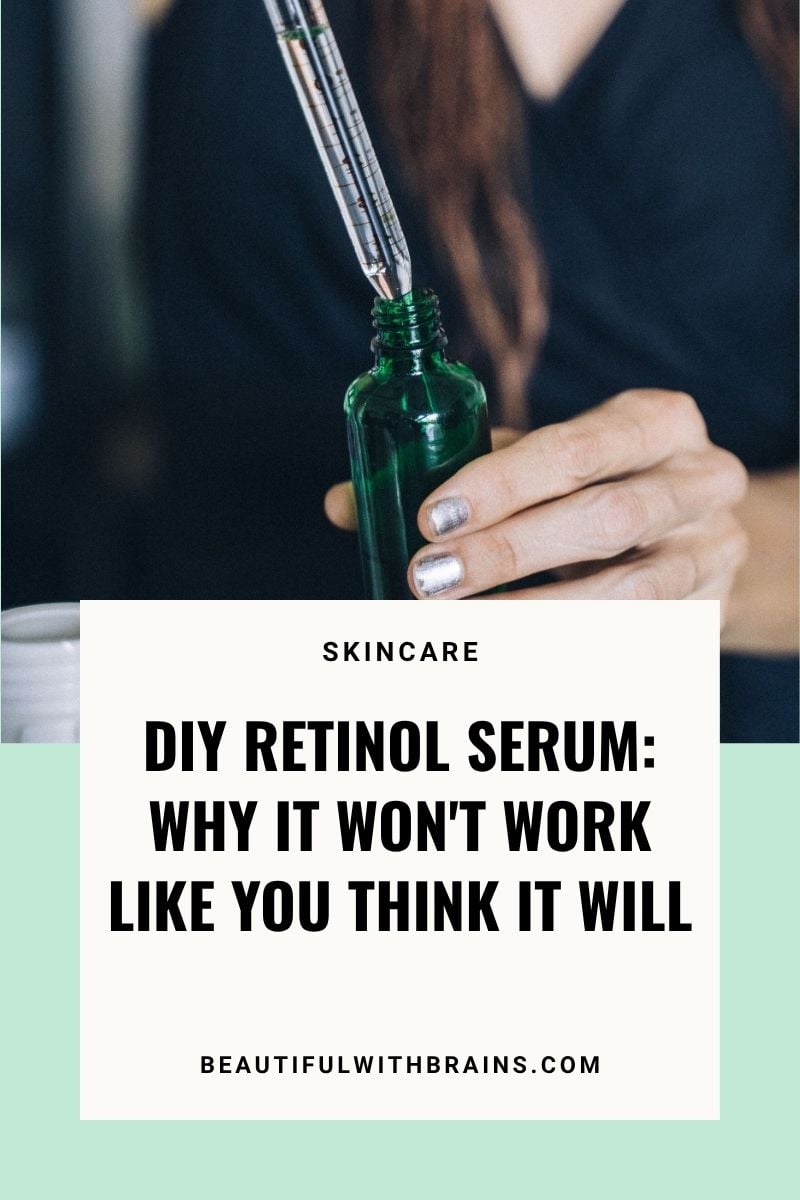
Retinol degrades rapidly without professional stabilization; DIY recipes can't replicate this, and natural oil "alternatives" don't have retinoid activity. Buy a properly formulated product instead.
DIY Retinol Serums: Why They Don't Work and What You Should Use Instead
A DIY retinol serum is any homemade skincare preparation that attempts to deliver retinol's anti-aging benefits by combining raw ingredients — typically oils, water-based liquids, and sometimes bulk retinol powder — outside a controlled cosmetic manufacturing environment. The core problem is that retinol is one of the most chemically demanding ingredients in skincare: it boosts collagen production, reduces the appearance of wrinkles and dark spots, and accelerates skin cell turnover, but it breaks down rapidly when exposed to light, oxygen, and heat. Getting it into a stable, safe, effective serum requires equipment and expertise that no home kitchen can replicate.
Before diving into the chemistry, here's a side-by-side look at how DIY retinol recipes compare to professionally formulated retinol products and the best-studied natural alternative:
| Factor | DIY Retinol Serum | Professional Retinol Product | Bakuchiol (DIY-Friendly Alternative) |
|---|---|---|---|
| Retinoid activity | Unreliable — degrades without stabilizers | Controlled; 0.025%–1% verified concentrations | Not a retinoid, but clinical evidence of retinol-like effects |
| Stability | High degradation risk (0–80% loss in 6 months possible) | Stabilized with antioxidants and encapsulation | Naturally more stable; oil-soluble |
| pH control | Difficult at home; pH 3 accelerates breakdown | Formulated to optimal pH range | Less pH-sensitive |
| Preservation | No reliable system for water-based formulas | Tested preservative systems included | Anhydrous oils need minimal preservation |
| Irritation risk | High — concentration impossible to control accurately | Dose-controlled; 0.3% shown as effective and better-tolerated than 1% | Lower irritation profile than retinol in clinical trials |
| Cost | Low upfront; high risk | Moderate to high | Low to moderate |
| Evidence base | None for DIY formulations | Decades of peer-reviewed clinical data | One 12-week RCT; promising but limited |
Why is retinol so difficult to formulate with?
Retinol is a fat-soluble form of vitamin A that the skin converts into retinoic acid — the active compound responsible for its anti-aging and skin-renewing effects. That conversion process is well understood. What's less appreciated by DIY enthusiasts is how aggressively retinol degrades before it ever reaches your skin.
A study of commercial retinoid products found potency losses ranging from 0% to 80% after six months at 25°C, with light causing even more degradation than temperature alone. Those are products made by professional cosmetic chemists using antioxidants, UV-blocking packaging, and encapsulation systems. In a home kitchen — clear glass bottles, ambient light, no stabilizing agents — degradation happens faster and more completely.
The pH problem compounds this. Retinol doesn't have a single ideal pH, but research has shown it breaks down significantly faster at pH 3 than at pH 7. If your DIY formula includes acidic ingredients — vitamin C, AHAs, certain botanical extracts — you may be actively accelerating retinol's breakdown without realizing it. Measuring and adjusting pH at home requires calibrated equipment most people don't own.
Concentration is the third variable that makes kitchen formulation genuinely risky. A study comparing 0.1%, 0.3%, and 1% retinol found that 0.3% and 1% produced similar improvements in markers of photoaged skin, but 0.3% was significantly better tolerated. The difference between 0.3% and 1% in a 30ml serum is 0.21ml of raw ingredient. Without a precision scale and proper dilution protocols, hitting that target is essentially impossible — eyeballing it means you're either wasting your time with a sub-therapeutic dose or risking real irritation with an excessive one.
What happens when you add water to a DIY retinol recipe?
Many DIY recipes call for water-based ingredients — aloe vera gel, rice water, hydrosols — alongside oils and retinol. The moment water enters the formula, microbial contamination becomes a serious concern.
Properly formulated water-based cosmetics rely on tested preservative systems to prevent bacterial, yeast, and mould growth. Research into cosmetic preservation uses microbial challenge testing to verify that a preservative system can actually control microbial growth under real-world conditions. A home formulator has no way to conduct this testing. What looks like a fresh, clear serum in a pretty bottle may be a growing culture of skin-damaging microbes within days or weeks.
Anhydrous formulas — pure oil blends — sidestep this particular problem but introduce their own: retinol doesn't dissolve or disperse evenly in all carrier oils, and without emulsifiers, a water-oil combination will simply separate. Either way, the formula is compromised.
Do "natural retinol alternatives" actually work?
This is where a lot of DIY skincare content crosses from optimistic into misleading. "Natural retinol alternative" in popular usage means any plant-derived ingredient claimed to mimic retinol's effects — but the clinical evidence for most of these claims is thin to nonexistent.
Rosehip seed oil is the most frequently cited offender. Rosehip oil does contain carotenoids, and some rosehip oils have been found to contain small amounts of naturally occurring retinoids. But "contains trace amounts" is not the same as "functions like a retinol product." The evidence for rosehip oil treating wrinkles and sun damage is nowhere near the body of research supporting topical retinoids. It's a good moisturizing oil with antioxidant properties — not a retinol replacement.
Carrot seed oil has antioxidant activity — research confirms this — but antioxidant activity and retinoid activity are mechanistically different things. Retinoids work by binding to nuclear receptors and altering gene expression. Antioxidants neutralize free radicals. These are not interchangeable functions. Carrot seed oil may be a pleasant addition to a face oil blend, but calling it a "natural retinol" is chemically inaccurate.
Bakuchiol is the one exception worth taking seriously. Unlike the oils above, it has actual clinical trial data behind it. In a 12-week randomized, double-blind study of 44 participants, 0.5% bakuchiol and 0.5% retinol both significantly improved wrinkles and hyperpigmentation, with no statistically significant difference between them. Retinol caused more scaling and stinging. The catch: bakuchiol needs to be applied twice daily to match the results of once-daily retinol. It's also not a retinoid — it works through different receptor pathways — so calling it a "natural retinol" is still technically imprecise. Of all the alternatives, though, it's the only one with meaningful clinical backing.
If you're looking for a DIY-friendly anti-aging oil blend, bakuchiol in a stable carrier oil is a reasonable starting point. Just don't call it a retinol serum, because it isn't one.
What are the real side effects of getting retinol wrong at home?
The DIY skincare community tends to focus on the upside — glowing skin, reduced wrinkles, money saved — and gloss over what happens when retinol is used incorrectly. The side effects are well-documented and can be significant.
Barrier damage is the first concern. Research has shown that retinoic acid can impair the skin's water barrier and increase transepidermal water loss. A compromised barrier means drier, more sensitive skin that's more reactive to everything else in your routine.
Inflammation and redness follow from excessive retinol use. Studies have linked retinol irritation to inflammatory responses in the skin. The classic signs — redness, peeling, burning — are well known enough that the skincare community has coined the term "retinol uglies" for the adjustment period. In a professionally formulated product at a controlled concentration, this phase is manageable. In a DIY formula where the dose is unknown, it can be severe.
Post-inflammatory hyperpigmentation (PIH) is the most underappreciated risk, particularly for darker skin tones. If retinol irritates the skin, that inflammation can trigger PIH — dark marks that can take months to fade. This is the opposite of what most people using retinol are trying to achieve. It's also why dermatologists consistently recommend starting with low concentrations, buffering with moisturizer, and building tolerance slowly — protocols that are nearly impossible to follow when you don't know what concentration you're actually using.
Does using a lower concentration make DIY retinol safer?
This argument comes up frequently in DIY skincare forums: if high concentrations cause problems, just use less. The logic sounds reasonable. The reality is more complicated.
Diluting retinol doesn't solve the stability problem. A 0.1% retinol formula in an unstabilized oil blend degrades just as readily as a 1% formula. You're left with a product that started weak and got weaker, with no way of knowing how much active ingredient remains by the time you apply it.
The sourcing problem is equally serious. Most home formulators buying retinol online are purchasing bulk powders from suppliers with no pharmaceutical-grade quality control, no independent purity testing, and no guarantee that the labeled concentration matches what's actually in the jar. The research showing retinol's benefits was conducted using verified, pharmaceutical-grade retinol in controlled conditions. Replicating those results with an unverified powder of unknown purity is not a reasonable expectation.
Low concentration or not, the fundamental issues — instability, pH sensitivity, preservation requirements, and sourcing uncertainty — remain unchanged.
What ingredients pair well with retinol in professional formulas?
Understanding what cosmetic chemists actually do to make retinol work helps illustrate why DIY approaches fall short. U.S. Dermatology Partners notes that professionally formulated retinol products are typically paired with several key ingredients.
Niacinamide helps reinforce the skin barrier and reduce the redness and irritation that retinol can cause — a pairing particularly useful for sensitive skin types and well-supported by clinical evidence. Hyaluronic acid counteracts the drying effect retinol can have; because retinol increases transepidermal water loss, a humectant that draws moisture into the skin helps offset this side effect. Peptides complement retinol's collagen-stimulating effects without adding to irritation load.
SPF is non-negotiable. Retinol increases photosensitivity, and Healthline notes that using it without sun protection can undermine its benefits and increase the risk of sun damage — one reason dermatologists recommend applying retinol at night.
What to avoid pairing with retinol: AHAs and BHAs (which can lower pH and increase irritation), benzoyl peroxide (which can oxidize retinol), and vitamin C in its ascorbic acid form (which is highly acidic and can destabilize retinol). These combinations aren't impossible to navigate, but they require careful formulation — another reason professional products are worth the investment.
What should you actually use instead?
The answer depends on what you're trying to achieve and your skin's tolerance level.
For anti-aging with proven results, a professionally formulated retinol product is the most evidence-backed option. Look for products that list retinol on the ingredient label (not just "vitamin A" or vague "retinoid complex" language), come in opaque or airless packaging to minimize light and oxygen exposure, and include stabilizing antioxidants like vitamin E or ferulic acid. Concentrations between 0.025% and 0.3% are appropriate starting points for most people; 1% is available but rarely necessary and significantly more irritating.
For sensitive skin or those new to retinoids, retinyl palmitate and retinaldehyde (retinal) are gentler retinoid forms that convert to retinoic acid more slowly. They cause less irritation while still delivering retinoid benefits, though they require more time to show results.
For a genuinely DIY-compatible option, bakuchiol in a stable carrier oil is the most defensible choice. A 0.5% bakuchiol blend in jojoba or squalane — both stable, non-comedogenic oils — can be made at home with reasonable confidence, since bakuchiol doesn't carry the same stability, pH, or preservation challenges as retinol. The clinical evidence for bakuchiol is limited compared to retinol, but it's real, and the safety profile is considerably more forgiving.
For hydration-focused DIY, skip the retinol entirely and make a simple facial oil with ingredients your skin actually needs: rosehip oil for fatty acids and antioxidants, sea buckthorn for carotenoids, or jojoba as a skin-identical wax ester. These won't replicate retinol's effects, but they'll genuinely moisturize and support your barrier without the risks of a botched retinol formula.
If you're interested in building a broader anti-aging routine, collagen-boosting serums that combine peptides, hyaluronic acid, and vitamin C can complement a retinol product without the formulation complexity of trying to combine everything in one DIY blend.
Who should talk to a dermatologist before using retinol?
Retinol is appropriate for most adult skin types, but several groups should get professional guidance before starting.
People with darker skin tones face a higher risk of post-inflammatory hyperpigmentation if retinol causes irritation. A dermatologist can recommend appropriate starting concentrations and pairing strategies to minimize this risk. People with rosacea, eczema, or a compromised skin barrier may find that retinol worsens their condition rather than improving it — there are gentler retinoid options, but the right choice depends on the specific condition.
Anyone who is pregnant or breastfeeding should avoid retinoids entirely. High doses of vitamin A are teratogenic, and while topical retinol absorption is low, the precautionary consensus among dermatologists is to avoid it during pregnancy. People taking oral retinoids (isotretinoin) for acne should not add topical retinol to their routine without medical supervision.
The bottom line on DIY retinol serums
Retinol is a first-generation retinoid requiring professional stabilization, pH management, and preservation to remain effective and safe. The gap between what a home kitchen can produce and what a cosmetic chemist can formulate is not a matter of effort or creativity — it's a matter of equipment, testing, and chemistry that simply isn't accessible outside a lab.
The natural oils promoted as "retinol alternatives" in most DIY recipes don't have retinoid activity. Rosehip and carrot seed oil are good skincare ingredients in their own right, but they don't bind to retinoid receptors, don't stimulate collagen production the way retinol does, and don't have the clinical evidence base to back up the claims made about them.
If you want retinol's benefits, buy a professionally formulated retinol product. If you want to make your own skincare, stick to ingredients that are stable, safe, and honest about what they can do. The two goals don't have to conflict — they just can't be achieved with the same product.
Sources
- DIY Retinol Serum: Why It Won't Work Like You Think It Will – Beautiful With Brains
- Retinol and skin aging – PMC (NIH)
- Stability of retinoid products – PubMed
- Retinol pH degradation study – PubMed
- Retinol concentration comparison (0.1%, 0.3%, 1%) – PubMed
- Cosmetic preservation and microbial challenge testing – PubMed
- Rosehip oil carotenoids and retinoids – PubMed
- Carrot seed oil antioxidant activity – PubMed
- Bakuchiol vs retinol RCT – PubMed
- Retinoic acid and transepidermal water loss – PubMed
- Retinol irritation and inflammation – PubMed
- Post-inflammatory hyperpigmentation and retinoids – PubMed
- Best Ingredients to Pair and Avoid with Retinol – U.S. Dermatology Partners
- Yes, Retinol Is Safe — When Used Correctly – Healthline
- Best Plumping & Collagen-Boosting Serums – EvIndexIndia